How to Invoice as an Expert Witness
Published March 15, 2026 · Updated July 29, 2026 · 10 min read
This content is for informational purposes only and does not constitute legal, financial, or professional advice. Rates, benchmarks, and practices vary by jurisdiction, specialty, and individual circumstances. Consult with a qualified attorney or accountant before making decisions about your practice.
For expert witnesses billing at $300 to $600 per hour, invoicing is not just an administrative task — it is a professional obligation. A poorly constructed invoice invites fee disputes, payment delays, and credibility attacks from opposing counsel. A well-constructed invoice, by contrast, serves as a defensible record of your professional services.
This guide covers everything you need to know about creating professional expert witness invoices that stand up to scrutiny from retaining attorneys, opposing counsel, and courts.
Why Expert Witness Invoicing Is Different
General freelance invoicing advice does not apply to expert witnesses. Your invoices may be subject to discovery under Rule 26. Opposing counsel may challenge your fees in a Daubert motion. Retaining attorneys expect itemized documentation that they can defend to their clients and the court.
The key differences include:
- Multiple rate structures: Expert witnesses typically charge different rates for file review ($250-400/hr), report writing ($300-500/hr), deposition testimony ($400-600/hr), and trial testimony ($500-750/hr). Your invoice must clearly reflect which rate applies to which activity.
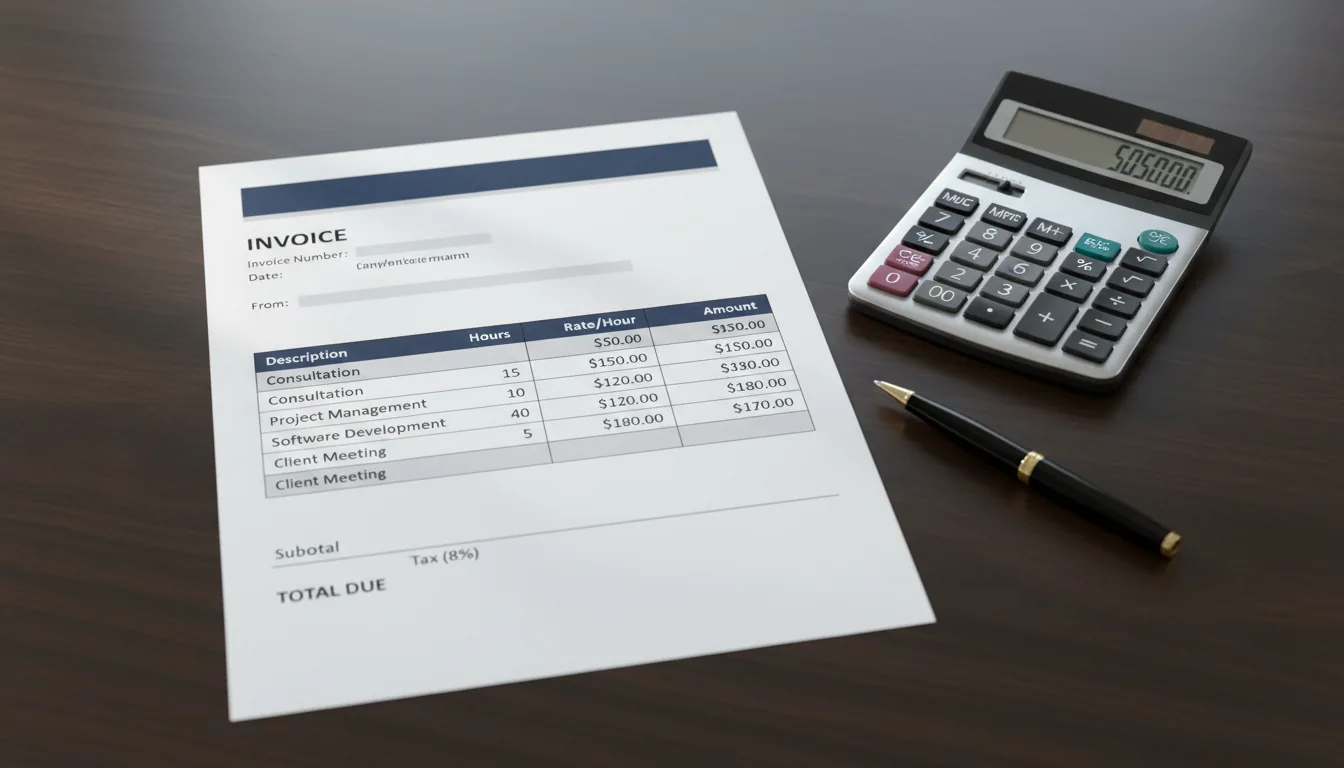
- Audit trail requirements: Every line item should include the date, activity type, time spent, rate charged, and a description of the work performed. This creates a defensible record.
- Professional presentation: Your invoice reflects your expertise. A handwritten summary on Word letterhead undermines the credibility you are being paid to provide.
- Legal context: Unlike typical business invoices, your invoices exist within a litigation context. They may be reviewed by opposing counsel, judges, and jury consultants.
Essential Elements of an Expert Witness Invoice
1. Professional Header
Your invoice header should include your full name, professional credentials (MD, PhD, PE, CPA), firm name, address, phone number, and email. This establishes your professional identity and provides contact information for the retaining attorney's accounts payable department.
2. Invoice Identification
Every invoice needs a unique number (sequential numbering like INV-0001, INV-0002 works well), the invoice date, the due date, and your payment terms (typically Net 30 for legal work). This is not optional — it is standard professional practice and essential for your own record-keeping.
3. Case Reference
Clearly identify the matter: case name, case number, court, and the retaining attorney's name and firm. This prevents confusion when an attorney is handling multiple cases or when invoices are processed through a firm's billing system.
4. Itemized Time Entries
This is the most critical section. Each entry should include:
- Date: The specific date the work was performed
- Activity type: File Review, Research, Report Writing, Deposition Preparation, Deposition Testimony, Trial Preparation, Trial Testimony, Travel, Conference/Meeting, Correspondence — travel time billing follows its own conventions, covered in our guide to billing for travel time
- Hours: Recorded in decimal format (1.25 hours, not "1 hour 15 minutes")
- Rate: The hourly rate for this specific activity type
- Amount: Hours multiplied by rate
- Description: A brief, professional description of the work performed
5. Rate Breakdown Summary
Below the itemized entries, include a summary showing total hours and amount for each rate category. This gives the retaining attorney a clear picture of where time was spent and makes it easy to verify the math.
6. Total and Payment Terms
The total amount due, payment terms, and any notes about retainer balances or previous payments. If you have a retainer on account, show the retainer balance, the current charges, and the amount due after applying the retainer.
Every invoice element above, generated automatically
ExpertPractice builds each of these elements into every invoice from your logged time — no manual formatting, no missed line items.
Common Invoicing Mistakes Expert Witnesses Make
Block Billing
Block billing — listing multiple tasks performed on a single day as one entry with a total time — is the most common mistake. Courts have reduced or denied fees for block billing because it makes it impossible to determine how much time was spent on each task. Always separate each activity into its own line item. Block billing is also one of the most common triggers for a fee dispute; see our guide to expert witness fee disputes for how to avoid and respond to one.
Vague Descriptions
Descriptions like "Research" or "File review" without additional context invite scrutiny. Better: "Reviewed plaintiff's medical records (Dr. Smith's treatment notes, 2023-2024, 47 pages)" or "Researched peer-reviewed literature on lumbar fusion outcomes, PubMed database."
Inconsistent Rates
Charging different rates for the same activity on different cases — or worse, on the same case — creates a credibility problem. Establish your rate structure clearly in your engagement letter and apply it consistently.
Missing Timestamps
If opposing counsel challenges your fees, having date-stamped entries with specific descriptions is your best defense. An invoice that just shows "40 hours of work at $400/hr = $16,000" is indefensible.
How to Handle Rate Changes
Expert witnesses periodically raise their rates. When you do:
- Notify the retaining attorney in writing before the change takes effect
- Apply the new rate only to work performed after the effective date
- Clearly show both old and new rates on invoices that span the transition
- Document the rate change in your engagement agreement or addendum
If you have not yet settled on a rate structure in the first place, our comprehensive guide to expert witness rate structure covers how to set rates by activity type before you ever need to raise them.
Payment Terms and Collections
Standard payment terms for expert witness work are Net 30, meaning payment is due within 30 days of the invoice date. Some experts require retainers (typically $5,000-$15,000 depending on the expected scope) that are drawn down as work is performed. For a fuller walkthrough of structuring these agreements, see our guide to expert witness retainer agreements.
For collections, maintain a professional approach:
- Send the invoice promptly — within a week of the billing period
- Follow up at 45 days with a polite reminder
- At 60 days, consider whether to continue work on the case
- Never withhold a report or testimony as leverage for payment — this creates ethical and legal problems
Automating Your Invoicing Process
The most efficient expert witnesses track time as they work, associating each entry with the correct case and activity type. When it is time to invoice, they select the unbilled entries for a case and generate a professional invoice automatically.
This approach eliminates the end-of-month scramble to reconstruct your hours from memory, reduces errors, and creates the timestamped audit trail that protects your fees from challenge.
ExpertPractice was built specifically for this workflow. You set up your case with its rate structure, log time entries as you work, and generate audit-trail invoices with a single click. Every entry is timestamped. Every rate is documented. Every invoice is defensible.
Key Takeaways
- Itemize every entry with date, activity type, hours, rate, and description
- Never block-bill — separate each activity into its own line item
- Use specific, professional descriptions that document what you did and why
- Maintain consistent rates across cases for the same activity types
- Include a rate breakdown summary for transparency
- Track time contemporaneously — do not reconstruct hours from memory
- Use professional invoicing software that creates an audit trail
Ready to upgrade your invoicing?
ExpertPractice generates audit-trail invoices with timestamped entries. 14-day free trial.
Start Free Trial