Billing a Retainer vs. Collecting One Upfront
I want to charge a retainer — do I record it as a payment, or log it as time and put it on an invoice?
Two Different Things That Both Get Called “Retainer”
ExpertPractice has two completely separate features that both cover money you call a retainer, and it's easy to reach for the wrong one:
- A case payment recorded as a retainer — money you note as received, that never appears on any invoice.
- A flat-fee time entry billed as a retainer — a real invoice line item for a fixed dollar amount, no hourly rate involved.
Which one you want depends on what you're actually trying to do.
Collecting a Retainer Upfront (Case Payment)
If a client already sent money to secure the engagement, before you've invoiced anything, record it from the case detail page's Payments & Retainer Credit panel. Choosing Retainer there logs that the client paid to commit to the case — it's tracked on the case, but it's never applied to any invoice, so it doesn't reduce a balance due anywhere.
This is a different choice than Advance Payment, which does sit as drawable credit against future invoices. See Recording Payments & Case Credit for the full breakdown of that distinction.
Billing an Owed Retainer on an Invoice (Flat-Fee Time Entry)
If instead the client owes you a retainer and you need to actually send them an invoice for it — so it shows up as billed revenue and they can pay it the same way they'd pay for any other work — that's not a payment at all. Log it as a time entry with Billing method set to Flat Amount, using a description like “Retainer fee” and the owed amount. Nothing about it is prorated by hours; the flat amount is exactly what bills.
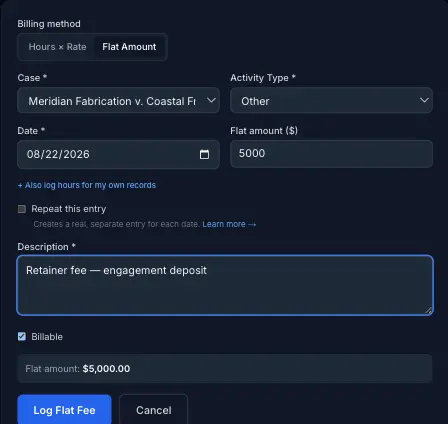
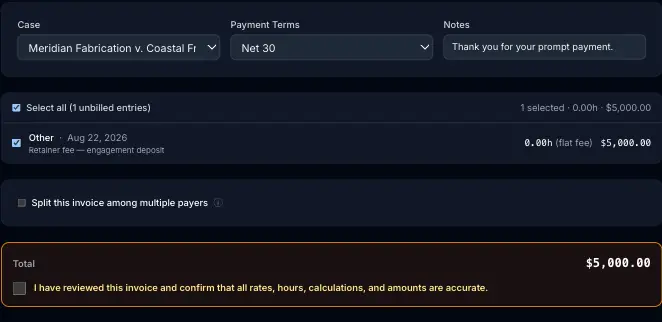
Once logged, it's an unbilled entry like any other — pick it up the next time you generate an invoice for the case, and it appears as a normal line item tagged (flat fee), with no hourly rate anywhere on it.
Which One Do I Want?
Ask: does this money need to show up as billed revenue on an invoice the client pays against? If yes, log a flat-fee time entry. If you're just recording that money already changed hands to secure the case — nothing to invoice, nothing to draw down — record a case payment instead.
They're not mutually exclusive, but don't double-count: if a client already paid a retainer as a case payment and you later bill them for the same amount, that's a separate charge on top, not the same money showing up twice.